


-768x768.webp)



-768x404.webp)


Which wall decorations to choose for a Japandi-style interior?
The Japandi style combines Far Eastern aesthetics with Scandinavian functionality and favours calm, natural materials and restraint in the choice of decorations. Below you will find suggestions that work beautifully in such an interior:
• Japandi wall mural – presents a cohesive composition inspired by nature, for example a landscape with a cherry tree, cranes, mountains or a rising sun. It consists of several strips which, once applied to the wall, form a single large-format scene.
• Japandi wallpaper is a subtle, repeating pattern assembled from successive strips on the wall. Designs such as gentle waves, small leaves or organic shapes and lines give the wall an interesting texture without overwhelming the interior. Japanese-style wallpaper works well as a backdrop for furniture made from natural wood.
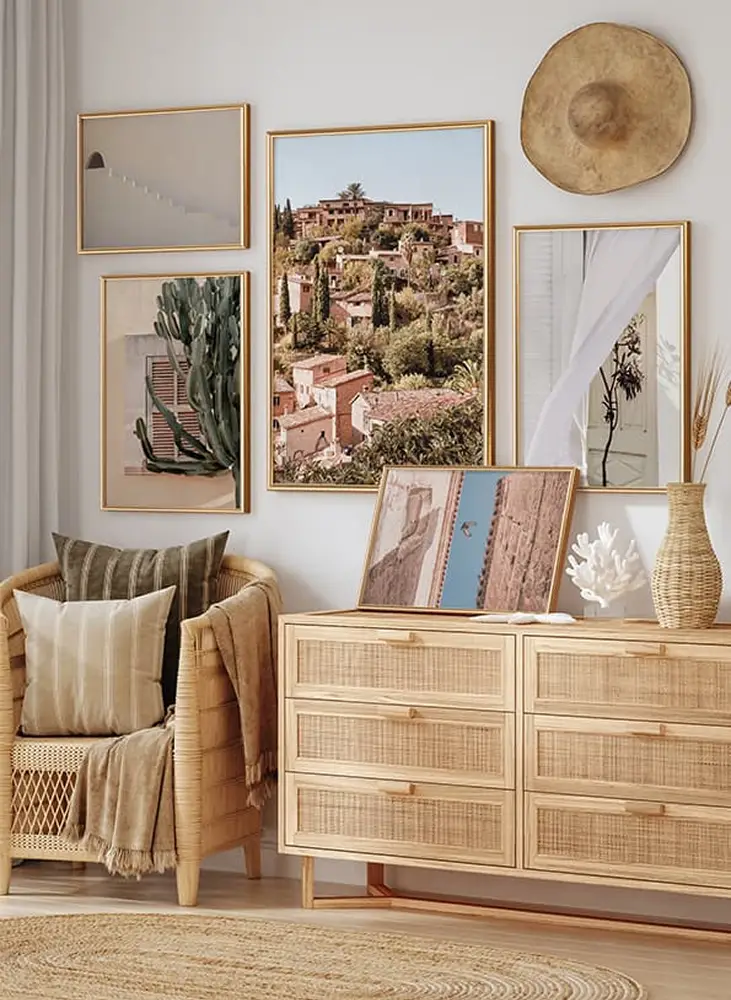
• Japandi canvas print is characterised by a calm, neutral colour palette. Abstract compositions, single-line portraits, cranes and delicate landscapes are motifs that align with the wabi-sabi philosophy. A larger wall can be filled with a Japandi canvas print set, for example in the form of a triptych.
• Japandi poster in a minimalist frame is a lightweight graphic with a restrained character, depicting botanical motifs, typography or minimalist illustrations referencing Japanese aesthetics. A good choice for those who value simplicity and modernity.

Bimago experts advise: how to choose wall decorations for the Japandi style
When selecting wall decorations for a Japandi interior, it is worth being guided by muted colours, natural motifs and restraint in the number of elements. The colour palette should revolve around neutral beiges, sandy shades, off-whites and greys, with possible accents of green or blue.
Proportions also need attention. A canvas print or poster looks best when it occupies about 60 to 75% of the width of the piece of furniture above which it hangs, for example a sofa or sideboard. The centre of the decoration should be placed at eye level, that is 145 to 155 cm from the floor.
In the Japandi style it is especially important to leave some free space around the wall decoration. Empty space is not a flaw here but rather a part of the arrangement, which thanks to it retains the lightness and calm typical of this style.
When choosing wall murals or Japanese-style wallpapers, pay attention to how the pattern works with the furniture and flooring. A fine, repeating design pairs well with furniture that has a distinct form, while a Japandi wall mural with a large motif looks better surrounded by simple, small pieces of furniture that do not draw attention away from it.
A Japandi-style arrangement is also worth complementing with a Japanese room divider, which references the traditional byōbu culture and makes an interesting accessory. In the living room, a Japandi room divider works well as an element separating the relaxation zone from the dining area, and in the bedroom it helps to create a separate space for a wardrobe or dressing table while decorating the room at the same time. Depending on the size of the room, you can choose a 3-panel decorative room divider for smaller rooms or a 5-panel one for spacious living rooms and bedrooms.
Japandi wallpaper or Japandi wall mural – which to choose?
A Japandi wallpaper is worth choosing when you want a subtle, repeating pattern that serves as a discreet backdrop to the arrangement. A Japandi wall mural, on the other hand, is the better choice when the wall is to become the main decorative focal point of the interior. If the interior is small, a Japanese-style wall mural with a depth motif such as a misty forest or distant mountains will visually enlarge the room. In larger spaces, a Japanese wallpaper with a delicate pattern gives the walls a subtle texture without the risk of dominating the interior.
A wall mural works better in rooms with few pieces of furniture against the walls, as its motif will be fully visible. Wallpaper, on the other hand, is more versatile and looks good even when part of the wall is covered by furniture or shelves.
An interesting alternative to wall decorations is a Japandi room divider. A Japanese room divider with a crane, cherry blossom or ukiyo-e wave motif references the tradition of dividing space known from Japanese interiors, while also decorating the room without any intervention on the walls. This is a good solution when there is no free wall space for a wall mural or canvas print, or when you want a decoration that can easily be moved to a different spot.

The most common mistakes when choosing wall decorations for the Japandi style
The most common mistakes when choosing wall decorations for the Japandi style stem from a misunderstanding of its overriding principle, namely restraint and harmony.
Mismatched pictures in different styles, shelves with trinkets and, on top of that, a wallpaper with a bold pattern on one wall is a simple recipe for visual chaos. In the Japandi style it is better to opt for fewer decorations, but chosen with precision.
When selecting a wall mural or wallpaper for a Japandi interior, avoid overly detailed, elaborate patterns. Gentle waves, subtle lines or a calm landscape work far better than a graphic full of fine details that would overwhelm the interior.
A common mistake is also a mismatch of shades. The Japandi style operates within a narrow colour palette, so even a seemingly small difference matters. A canvas print in cool greys hung next to furniture in warm, honey-toned wood can disrupt the coherence of the entire arrangement. Before buying, it is worth holding colour samples against the wall and furniture to check whether the shades work together.
When purchasing a Japandi canvas print or poster, the frames also deserve attention. A plastic, glossy frame in an arrangement based on natural wood, linen and stone will clash with the entire aesthetic of the interior. It is better to opt for frames in light wood or black metal, or to forgo a frame altogether in favour of a canvas stretched on a stretcher bar.
FAQ – Frequently Asked Questions
Japandi wallpaper or Japandi wall mural – which to choose?
A Japandi wallpaper is a repeating pattern printed on even strips that gives the wall a subtle texture. A Japandi wall mural is a single large motif made up of several strips, covering the entire wall. Choose wallpaper when you want a delicate backdrop, and a wall mural when you want the wall to catch the eye.
Japanese wallpapers – which motifs suit the Japandi style?
The Japandi style is best complemented by Japanese wallpapers featuring cherry blossom, ukiyo-e-style waves, misty landscapes, cranes or subtle geometric patterns. It is worth choosing motifs that are muted and restrained in form, so the decoration does not dominate the rest of the arrangement.
Which interiors suit Japandi wallpapers?
Japandi wallpapers work not only in Japandi-style interiors but also in Scandinavian, minimalist and Zen- and wabi-sabi-inspired arrangements. They suit any interior where a calm, natural aesthetic is the priority.
Japandi wall mural in the living room – how to incorporate it well?
A Japandi wall mural is best placed on the wall that is visible immediately upon entering the living room, or on a wall where not many pieces of furniture stand. The remaining walls should be kept smooth and in a neutral colour, so the wall mural remains the main decorative element and does not compete with other patterns.
On which wall in the living room should you apply a Japandi wall mural?
A Japandi-style wall mural is best applied to a wall without windows or doors, away from large furniture. An uninterrupted, free surface allows the motif of the wall mural to be displayed to its full effect.
Japandi poster – which motifs to choose for the living room?
For the living room, a Japandi poster with a nature motif works best – such as a cherry branch, a minimalist mountain landscape, cranes or an abstract composition in beiges that underline the warm, natural character of the interior.
Japandi canvas print in a frame – how to display it stylishly?
A Japandi canvas print looks best on an empty wall, away from other decorations. The centre of the picture should be placed at a height of 145 to 155 cm from the floor. It works well in a frame of light wood or black metal, as well as frameless on a stretcher bar.
How to arrange a Japandi canvas print set on the wall?
A Japandi canvas print set in the form of a triptych or pentaptych is best hung with even gaps of 5 to 8 cm between frames, in a single horizontal line at eye level. The entire composition should cover about 60 to 75% of the width of the piece of furniture below, for example a sofa or sideboard.
Links to collections
Canvas prints
Japanese Canvas Art
Japanese Wall Murals
Japan Wallpapers